
Important Security Notice: Beware of Fraudulent Messages!
Protect Yourself Against Phishing and Fake Booking Confirmations.
Fraudsters repeatedly attempt to impersonate hotels or their employees. Guests may be contacted via WhatsApp or email and asked to confirm their reservation, verify their booking details or re-enter their payment information.
What makes these messages particularly deceptive is that they sometimes contain accurate personal information, such as your full name, arrival and departure dates or other details relating to your reservation. This can make the messages appear genuine at first glance.
Please be aware: Not every message containing accurate booking details and claiming to be from a hotel actually originates from that hotel.
What You Should Know
We will never contact you from unknown phone numbers or through unsolicited messages asking you to:
- Confirm or validate your booking via an unfamiliar external link.
- Re-enter your credit card or bank details through a link sent to you.
- Provide your payment information outside our official and recognised booking channels.
- Complete an allegedly mandatory reservation confirmation under time pressure to avoid losing your room.
Do not let yourself be pressured, even if a message contains your name, travel dates or other accurate booking information.
Important: Accurate booking details do not prove that a message genuinely comes from us.
How to Identify Fraudulent Messages
Pay particular attention to the following warning signs:
Personal information: The message contains genuine booking details, even though you do not recognise the sender.
Unknown phone numbers: You receive a WhatsApp message from a foreign or unfamiliar phone number.
Suspicious links: You are asked to confirm your booking via a web address that does not belong to our official website or a booking platform you recognise.
Time pressure: You are told that your reservation must be confirmed within 24 hours, otherwise your room may be released.
Repeated payment requests: You are asked to re-enter your credit card details or other payment information.
Examples of Fraudulent Messages
The following examples show actual fraudulent attempts reported by guests. They illustrate the different ways in which these messages can be designed.
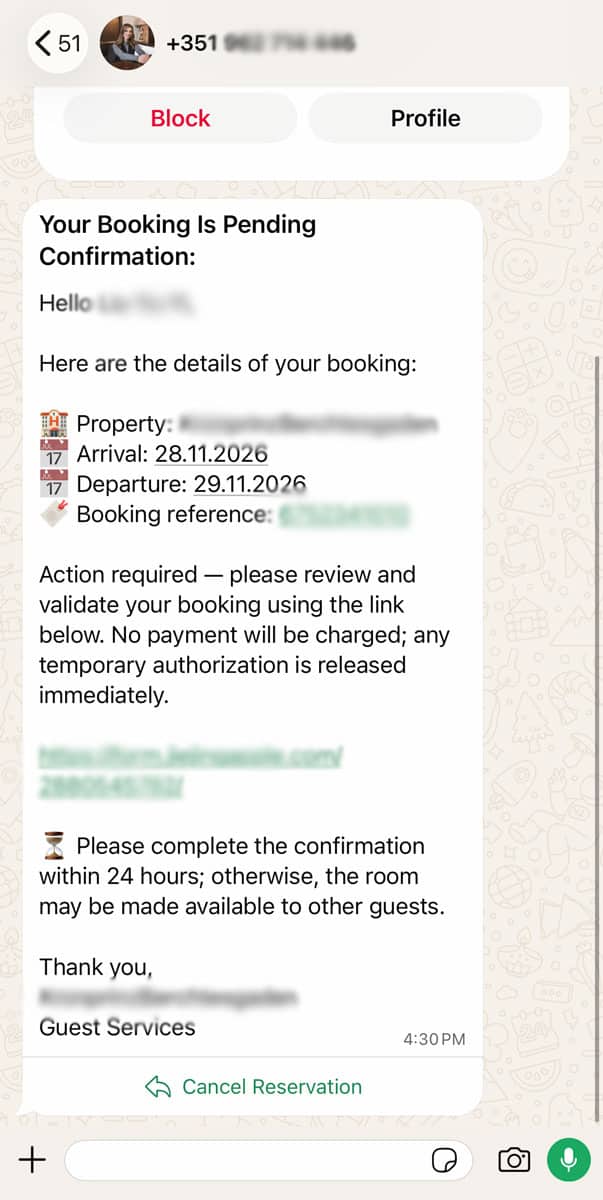
Example 1: Fake Booking Confirmation via WhatsApp
A guest received a WhatsApp message addressed to them by their full name and containing their actual arrival and departure dates.
The message claimed that their booking was still pending and had to be confirmed via an external link within 24 hours. Otherwise, the room could be released and made available to other guests.
Although the personal details were correct, the booking reference provided did not match the actual reservation. The message had not been sent by the hotel.
Typical wording used in the fraudulent message:
Your booking is pending confirmation.
Action required – please review and validate your booking using the link below.
Please complete the confirmation within 24 hours; otherwise, the room may be made available to other guests.
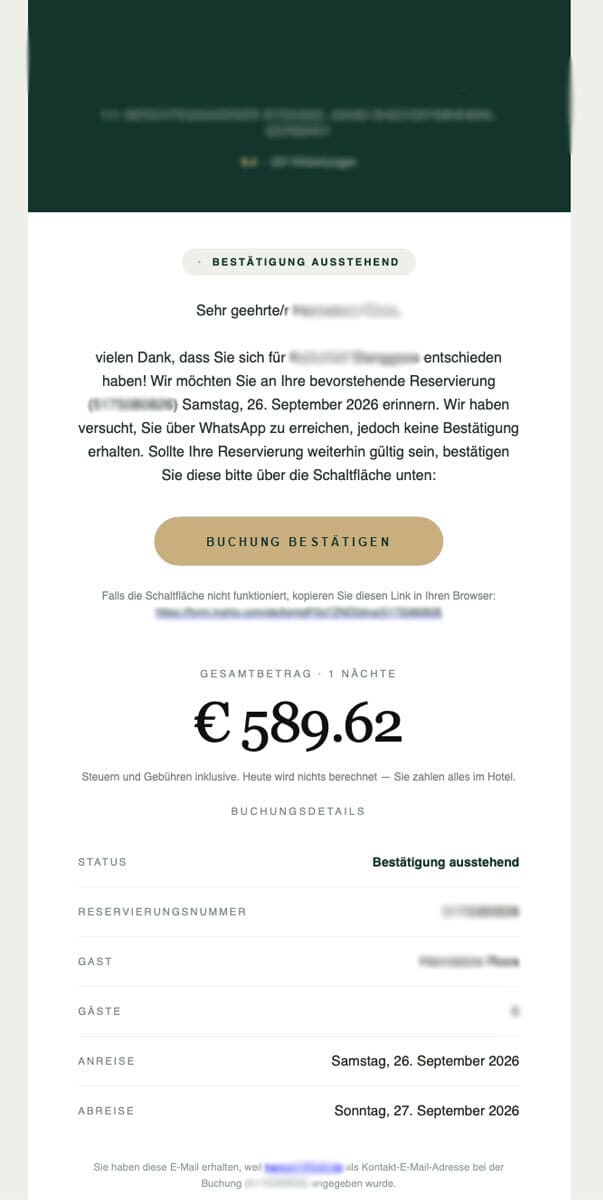
Example 2: Fake Booking Confirmation via Email
Fraudulent messages can also be sent by email. Scammers use professionally designed booking confirmations that appear to come directly from a hotel or booking service.
In this example, the guest is informed that their booking confirmation is still pending. Under the pretext that a previous attempt to contact them via WhatsApp was unsuccessful, they are asked to reconfirm their reservation using a button or external link.
These emails may contain genuine booking information, such as the guest’s name, travel dates, reservation number and even the alleged total amount.
Warning: Even professionally designed emails containing accurate booking details can be fake. Do not click on any links or enter personal or payment information.
What Should You Do If You Receive Such a Message?
- Do not click on the link. Do not open unfamiliar websites or download suspicious attachments.
- Do not enter any personal information. Never share credit card details, passwords, TANs or other personal information.
- Do not reply to the message. Stop communicating with the sender and block the number or email address if necessary.
- Contact us directly. Only use the telephone number or email address listed on our official website.
- Report the incident to us. A screenshot of the message will help us assess the attempted fraud.
If you have already clicked on a suspicious link or entered payment details, contact your bank or card provider immediately and have your card blocked if necessary. If you have entered any passwords, change them immediately.
Unsure Whether a Message Is Genuine? We Are Here to Help.
Your security and the trust you place in us are our highest priorities.
If you receive a suspicious message or have any doubts about the authenticity of a communication, please contact us directly. We will be happy to check with you whether your reservation is valid and confirmed.
For all enquiries, please use our official contact details only.
Thank you for your attention and trust!